


FAQ & INFO PAGE

Delight yourself in the Lord; And He will give you the desires of your heart. Psalm37:4
HOW TO RESERVE A KITTEN
If you find the kitten of your dreams and availability has been confirmed, reserving your kitten is simple. A $400 deposit is typically required to hold a specific kitten. The deposit is applied toward the purchase price and is non-refundable, but it may be transferred twice to another kitten or litter if requested before the originally reserved kitten reaches five weeks of age.
To confirm availability and make arrangements, please contact me at 813-295-4807 or purrepiphany@gmail.com. I do my best to keep the website and Facebook page updated as quickly as possible; however, deposits may be received before updates are posted, so please always check with me directly.
For your convenience, electronic money transfers and personal checks (time permitting) are accepted for deposits or for full payment if received at least seven days prior to pickup. If a balance remains on pickup day, it must be paid in cash.
Once your deposit is received, I will email you a Kitten Deposit Agreement and Kitten Prep & Care Guide, which includes the pickup date, feeding information, and general care details. Please review this information carefully and confirm receipt by replying to the email.
After a deposit is received—or when one is expected—your kitten will be marked on the website as “pending” or “reserved,” depending on deposit status. Deposits are not accepted directly through the website, as I prefer to speak with you beforehand. Please contact me by phone, text, or email to confirm availability and discuss details before sending payment. Kittens cannot be held without a deposit.
Each kitten is given a temporary ID name between two and four weeks of age, often based on a theme shared by the litter. This helps me build a personal connection with each kitten and ensures accurate identification throughout their care. Kittens are also color-coded with ID collars. This system helps provide peace of mind for new families and allows the veterinarian to accurately match each kitten to their individual health certificate. By the time kittens go home, I know each one well without needing color coding—but it helps ensure every kitten leaves with their correct documentation.
-
If you would like to reserve a kitten, please contact me by phone, text, or email. I will confirm that the kitten you are interested in is available. Once your deposit/down payment is received, I will email you a Deposit Agreement. Please review the agreement carefully and acknowledge your acceptance by replying to the email.
-
You will also receive a Kitten Prep & Care Guide filled with helpful information, a supply checklist, and steps to take before your kitten’s pickup date. If you have any questions at any time, please feel free to reach out.
-
Clear communication helps ensure a smooth and pleasant experience for everyone. You may contact me by text, phone, or email.
-
I post photos and videos regularly on Facebook. “Follow” my page, so you don't miss a thing.
-
For health and safety reasons, kitten pickups take place in a prepared area of our home, a practice we began during the pandemic and have continued.
-
To protect the kittens, they are not handled by anyone outside my immediate family prior to sale. There are many contagious feline illnesses, and I encourage buyers to research this topic in advance.
-
Copies of my Deposit Agreement and Purchase Agreement are available upon request
To learn more about adopting one of our kittens please scroll down to the section Adoption Info
SHIPPING
Kittens may only travel in the climate-controlled cabin, under the seat, in an airline-approved carrier, accompanied by you or your chosen travel guardian. Cargo shipping is not permitted.
Our closest airport is Tampa International (TPA). Kittens must be picked up at our home. Many families choose to fly in to meet and collect their kitten—some returning home the same day, while others enjoy time visiting family, exploring Disney, or vacationing in sunny Florida before pickup.
Alternatively, professional pet transporters may be hired to bring your kitten to you. I can confidently recommend several experienced transporters who have successfully worked with our families in the past.
BEWARE OF SCAMS
While this may not be a new concern, scams in the pet world have become increasingly sophisticated. Many scammers operate like full-fledged businesses, making them difficult to spot at first glance.
The simplest and most important advice I can offer is this: speak with the breeder by phone. A reputable breeder should also have a website, and while some legitimate breeders are newer and may have recently launched their site, there are ways to see whether a website has an established history. It’s important to look at the entire picture.
A legitimate breeder should maintain an active social media presence, most commonly on Facebook or Instagram. Take time to review their posts, read comments, and look at engagement. If possible, follow them for a while—you’ll quickly see whether they are consistently active and transparent. You can also search the breeder’s personal name on social media to gain additional insight.
I primarily use my Facebook page and occasionally post on Instagram. While scammers do create websites and social media accounts, they often have to shut them down and start over once reported. Consistency and longevity matter.
As with any major purchase, if something seems too good to be true, it probably is. Never send money without doing your due diligence. Beyond an initial deposit, you should not be asked to send additional unexpected payments.
Finally, carefully research any pet transporter you are considering. I have heard of scams where one entity posed as both the breeder and the transporter, collecting money from buyers under both identities.
Taking the time to research and ask questions can save you a great deal of stress and heartbreak.
How old will my kitten be when he can go home?
Kittens go home at no earlier than 8 weeks of age. At this age, they meet the Florida requirement for a Health Certificate, which is legally required for the sale of pets in Florida. By eight weeks, kittens have been eating solid food, drinking water, and consistently using the litter box for several weeks.
Will my kitten be spayed or neutered before he goes home?
No. Kittens go to their new homes at approximately 2–3 months of age. Spaying and neutering is recommended between 9-10 months of age, when your kitten is developmentally ready for the procedure and before they are sexually mature.
Will my kitten be litter trained?
Yes. Your kitten will be consistently using the litter box by the time he goes home.
What comes with my kitten?
Your kitten will come with:
○ Official Certificate of Veterinary Inspection, commonly referred to as a health certificate. This certificate is required by law for sales of pets in Florida and includes first shots, a prophylactic deworming, physical exam, negative parasite checks, and negative FeLV/FIV test.
○ A Purchase Agreement and Kitten Prep & Care Guide.
○ CFA Registration- given later, upon request - once kitten is fixed (at 9-10 months of age, according to my contract).
○ A gift bag with at least 4 days worth of kitten foods, comb to promote grooming, a few of his favorite toys, a soft blanket and stuffed toy scented by mom and siblings to comfort your baby during transition to new home. Other items may be included, depending what's available.
○ Clean coat, sanitary trim and nail trim.
○ 30 days of free Pet Insurance through Trupanion.
○ A lifetime of guidance from myself, as you navigate your journey.
ABOUT THE BREED
Persian cats are an ancient and well-known breed, cherished for their calm, gentle, and docile nature. They are truly domesticated companions, known for being quiet, easygoing, and affectionate.
Their beautiful coats do require regular care. Frequent brushing—or, if preferred, maintaining a professional clip—keeps the coat healthy and comfortable. With light brushing every other day, a Persian’s coat can remain tangle- and mat-free, making grooming a pleasant experience rather than a chore. When grooming is done consistently and gently, it often becomes a special bonding time enjoyed by both cat and owner.
If coat care is neglected and tugging, pulling, or shaving becomes necessary to “catch up,” a cat may begin to dislike grooming. Proper, regular care helps prevent this and keeps your Persian comfortable and happy.
In terms of behavior, Persians are rarely mischievous or overly energetic. They don’t tend to bounce off the walls like some other breeds, yet they are still playful, curious, and delightfully whimsical. Beautiful, relaxed, and loving, Persians are—at least in my opinion—the classic and most enduring house cat breed.
Before the 1980s, the Himalayan cat was not considered a Persian by the CFA (Cat Fanciers’ Association). Because of this, many people still think a Himalayan is a separate breed. While some registries around the world may treat them as distinct, according to the CFA—the largest pedigreed cat registry in the world—the Himalayan is officially a Persian.
The Himalayan variety was first developed in the 1930s by crossing Persians with Siamese cats. Over the next 50 years, breeders worked to reduce Siamese characteristics, accentuate the Persian attributes, while retaining the distinctive color-point markings.
By the 1980s, the Himalayan had completed the CFA’s requirements for a new color division and was officially recognized. Today, the CFA considers Himalayans just one color division of the Persian breed, much like Shaded Silver, Bi-Color, Tabby or other color divisions. Because of this, Himalayan Persians are sometimes referred to as “color-point Persians” to reduce confusion.
As a Persian, a Himalayan should possess all the classic Persian traits: a round head, short ears and nose, a cobby build, a full coat, and a calm, docile temperament. Not all long-haired cats with Siamese-style markings are Himalayans; other breeds, such as Birmans and Balinese, also display color-point patterns.
DOLL FACE OR FLAT FACE
The various degrees of Doll Face and Flat Face are all precious! These terms are used by Persian enthusiasts to describe a cat’s facial structure and expression. While the Show Face is formally defined in the Persian Cat Breed Standard, all other face types have no official description—so interpretations vary widely among breeders. Naturally, breeders rarely agree completely.
Most agree there are five main face types, including the show face, the Doll Face to the extreme Flat Face. Here’s a breakdown:
-
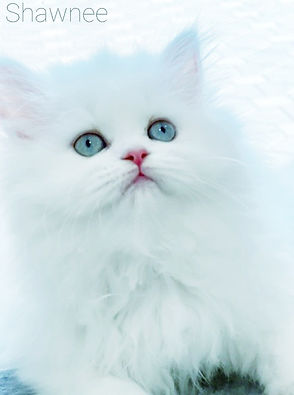
Full Doll Face – Features a more typical “cat-like” face, although by comparison theirs is still a bit rounder and shorter in nose and ears than a typical cat, yet these features are not as short as on cats with the other face types. Doll Face cats often have a long, plush, silky, lower-maintenance coat.
-
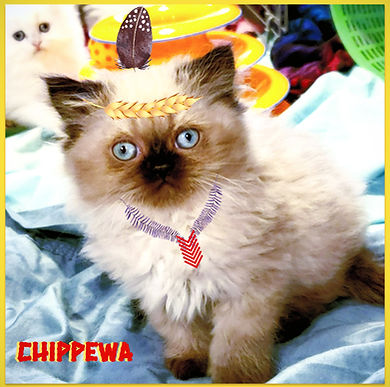
Doll Face – Adorable and sweet, with nose situated well below the eyes, avoiding most health concerns common to the flatter face types. Coats can either be long, plush and silky or full and cottony.
-
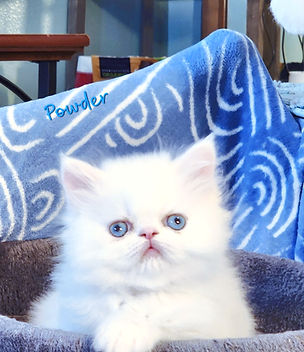
Short Doll Face – Face is much flatter than the Mid Doll Face with a slightly pushed-in nose set just below the eyes, somewhat shorter ears, and large eyes, with possible tearing. Coat is typically fluffy, cottony, and full.
-
Flat Face – Also called Peke or Extreme Face, this is the face type often associated with the breed, characterized by a nose positioned high between the eyes. Very cute, rounded head, cobby build, and full fluffy cottony coat. Teary eyes often occur, but the sheer adorableness keeps this style popular.
-
Show Face – This type is very flat but a wide “open expression.” Eyes are round, ears small and both are widely spaced, the mouth an upside down "v" and the body is cobby with short legs and tail. Coats are long, full, luxurious, but require the most maintenance.
Other features often accompany these face types. For example, cats with less extreme Doll Faces usually have slightly longer ears, legs, and tails, minimal tearing, and silkier, easier-to-care-for coats. These “Doll Faces” are often ideal for busy households. The Show Face, by contrast, is more high-maintenance but represents the modern Persian standard perfectly. Between these two extremes, there are endless variations, offering a wide range of facial expressions and coat types.
Historically, the original Persian cats brought from Persia (now Iran) had long hair with a more typical cat face. Over time, breeders selected for flatter faces, then, recognizing some of the health concerns with the extreme flattening, some breeders have worked to reintroduce more natural facial structures while still retaining the signature look people expect in a Persian.

In this drawing I created, you can see how nose placement helps identify a Persian’s face type.
-
The cat on the left has its nose set high between the eyes—this is considered a Flat Face, sometimes called a Peke-Face or Extreme Face.
-
The cat on the right has its nose set lower, characteristic of a Doll Face.
This visual makes it easier to understand the differences and see how cats can fall anywhere along the spectrum between Doll Face and Flat Face. Just as shades of the same color can differ, not every face fits perfectly into a single category—there is a natural range of variation.
RECAP: The Flat-Faced Persian is known for having a smaller, more cramped sinus cavity, which can lead to breathing challenges, especially if the nose is tiny. However, in my experience, as long as the nose is proportionate and not obscured by folds of skin, these cats generally breathe well.
Flat-Faced Persians do tend to experience more eye tearing, which can result in staining under the eyes, and may also be more prone to dental issues earlier in life. Because of the tearing and stains, my Blue-Eyed White Persians I intentionally breed towards the Doll Face and Mid Doll Face types for cleaner faces.
The Show face does have a Flat Face but with features that meet the current Persian breed standard. Along with a cute button nose tucked up between the large round eyes, they have very small little ears, short tails, legs and overall body is cobby.
Sometimes breeders of one face type will disapprove of the other types. But the bottom line is, everyone has their own preference. At some point in the history of the Persian cat all the various face types existed and were predominant.
In summary, the Doll Face Persians are gorgeous as long as they still look like a Persian. They should still have an adorable round head with the cute Persian features. They should still have a full and beautiful coat, though it is often more silky, and easier to care for, than their flat face counterparts. Flat Face Persians have classic Persian features, but they are a little higher maintenance because of their often thicker coats and tearing eyes.
All in all, the Doll Face Persian is beautiful, with less work, but who can resist the pushed up snobby nose or the "grumpy cat" frowny mouth of the Flat Faced Persian. We have the genetics for four types and as a result we do producing varying degrees of Persian expression and it is totally up to you to choose what you like.
FULL DOLL FACE


DOLL FACE
SHORT DOLL FACE

FLAT OR PEKE FACE


ADOPTION INFO Click here to see our Available Kittens
Welcome to Purr Epiphany Himalayans & Persians
We are a small in-home breeder of truly adorable Persian and Himalayan kittens. Our cats are first and foremost our beloved pets, with full run of our home. They lounge on the furniture, soak up the sun on our large screened porch (with 24/7 access), and—quite honestly—act like they own the place 😊.
We intentionally keep our numbers small so each cat receives the individual love, care, and attention they deserve.
At Purr Epiphany Persians, health is our top priority. All of our adult cats are DNA tested and certified negative for Polycystic Kidney Disease (PKD), a serious inherited kidney disease found in some cat breeds, including Persians. PKD has no cure and can cause kidney failure as early as two to three years of age. Our cats are also tested and negative for Feline Leukemia (FeLV) and Feline Immunodeficiency Virus (FIV). Each kitten is tested for FeLV and FIV during their pre-placement veterinary exam.
We specialize in Doll Face Himalayans and Persians, though we are occasionally blessed with an adorable flat/peke-faced baby. Our program focuses on stunning Himalayan Persians in dark seal, chocolate, blue, flame, cream and lilac points, all with beautiful blue eyes.
Thank you for visiting our website. If you have any questions, please don’t hesitate
to contact me at 813-295-4807 or purrepiphany@gmail.com.
Be sure to Follow us on Facebook page to see our day-to-day activities.
Hope to see you there!
If you see a kitten that melts your
Please contact me by phone (call or text) or by email to discuss details and deposit arrangements:
813-295-4807 | purrepiphany@gmail.com
Once you reserve one of our kittens, you become part of the Purr Epiphany family. From that day forward, you are always welcome to reach out for advice or guidance regarding your kitten.
After your deposit is received, I will email you a Deposit Agreement/Receipt along with my Kitten Prep & Care Guide. This includes a checklist of supplies you’ll need and steps to take to prepare for your kitten’s arrival. Please review the agreement and confirm your understanding by replying to the email. If you have any questions, don’t hesitate to contact me.
Clear communication is appreciated and helps ensure a smooth, pleasant experience. Text messaging is my preferred method of communication and is the quickest way to reach me.
If you haven’t already, please Follow Me on my Facebook page, Purr Epiphany Himalayans, where I regularly post photos and videos as the kittens grow. Clicking the "Follow " button will ensure you see all updates. If you need the link, just let me know.
Kittens visit the veterinarian for their health certificate and first vaccinations the day before their scheduled pickup. If you are traveling a long distance—especially if combining your trip with family visits or Florida theme parks—I recommend planning pickup within one to two days after the original date. This allows time to confirm the health certificate and, in the rare event a fecal exam shows an issue, to complete treatment and receive a clear result. Please reach out if you would like clarification.
To reduce the risk of illness transmission, kitten pickups take place in a prepared area of our home. We ask that you reschedule if you are not feeling well. Pickup times are scheduled no earlier than 12:00 PM to allow kittens time to eat, play, use the litter box, and rest before heading to their new home.
For health and safety reasons, kittens are not handled by anyone outside my immediate family prior to sale. Many feline illnesses are highly contagious, and veterinary offices—while professional—do see sick animals daily. Even minimal exposure can pose a risk to young kittens.
Thank you for your understanding and cooperation. We truly appreciate it.
Our Deposit Policies
A $400 deposit is typically required to reserve a specific kitten. Most kittens are priced from $1500- $2,000, depending on the season. The deposit is applied toward the total purchase price and is non-refundable. However, if I am unable to fulfill the reservation within a reasonable timeframe, the deposit will be fully refunded.
Deposits may be transferred up to two times to a different kitten or litter, provided I am notified before the originally reserved kitten reaches five weeks of age.
The remaining balance is due in cash only on the day of pickup. No electronic payments, checks, money orders, or other forms of payment will be accepted at pickup.
Deposits on unborn or newborn kittens are accepted based on a specific color and/or sex preference. You will be notified once a kitten can be confidently identified as meeting your selection. If multiple deposits are placed for the same color/sex, kittens are chosen in the order deposits are received. Your position in line is provided at the time your deposit is made.
Once kittens reach five weeks of age, the first depositor will make their selection, followed by the next depositor, and so on. Additional details regarding deposit policies and procedures can be found on the Info page of this website.
Please note that deposits and payments are not accepted through this website, and my application process is done by direct communication. To reserve a kitten, please contact me by phone, text, or email ~ 813-295-4807 ~ purrepiphany@gmail.com
Explaining The Picking Order (for selecting your kitten from the litter)
Here's a little explanation of the picking order and how it all works. If you've placed a deposit for an already named kitten this doesn’t apply to you since you already know which kitten you're getting.
Named kittens are have been given a unique litter name and a colored collar to identify them. Their litter name is temporary, you can keep it or change it. The names usually fit with a theme which helps me identify him down the road by the season he was born.
If you've placed a deposit on an unnamed kitten, either not yet born or under the age of 5 weeks, you will be given a picking position based on the date your deposit is received (the picking order goes in the order the deposits are received) and the color and sex of the kitten you'd like.
For those not sure which color or sex, and even those who are open to any, you can make a first choice and a second choice of color/sex. Your second choice, however, doesn't come before someone who has chosen that specific color/sex as their first choice. But it does give me an idea of possibilities and alternatives since we can't predict what colors and sexes we will get in a litter. We practice flexibility and it always works out. I will make a notation in our agreement with your first and second color/sex choices. If the available choices aren’t what you’re wanting, let me know ASAP but no later than 4 weeks, so the line can move on. You can roll your deposit over twice before your deposit is forfeited. In other words, if you don’t take the third kitten available to you, deposit is forfeited.
Between the age of 4-5 weeks, sometimes sooner, the 1st pick person of a specified color and sex will choose their choice from amongst the appropriate named and color coded kittens. After they have chosen, the remaining kittens are then chosen from by the 2nd pick person. And then the third chooses and so on. Your deposit guarantees you to be in the picking line as the kittens are born. Those with deposits will have a chance to choose before kittens are offered to those without a deposit.
Any Questions, please reach out 😊 813-295-4807
Outline of my Kitten Health Warranty
○ I cover 48 hour return period if your vet finds and verifies a serious undocumented condition.
Remedy- return of kitten and replacement
○ I cover contagious sicknesses, for up to 2 weeks after pick up, that would have come from my environment.
Remedy- return of kitten and replacement
○ I cover congenital or hereditary defects that cause death or are imminently terminal, requiring aggressive treatments or euthanasia.
Remedy - replacement of kitten
○ I do not give refunds.
○ I do not cover auto immune diseases or injuries.
○ Your kitten comes with 30 days free insurance through Trupanion Pet Insurance, which you can choose to continue or not.
OPINIONS
I’d like to address the subject of opinions, as this is something that often comes up when people speak with multiple breeders. Breeders—like veterinarians, trainers, and owners—have strong opinions on many topics: the best food, the best litter, how often to bathe, and even the “right” age for a kitten to go home. These opinions are shaped by personal experience, what someone has read or been told and believes from someone else, and how well they apply their own common sense. Naturally, not everyone agrees—and that’s perfectly normal.
I have my own opinions as well, formed through decades of experience, research, observation, and yes, a fair amount of overthinking. Rather than cover every topic, I’ll focus on one that comes up often: the age at which a kitten should go to their new home. Some breeders believe kittens should stay until 12 weeks or older. That belief did not arise randomly—there are historical reasons behind it.
Years ago, most cat breeders were show breeders, not pet breeders. Average families did not buy cats. The show breeder's goal was to produce show-quality cats, which requires time to evaluate structure, temperament, bite, coat, and overall development. Kittens were kept longer so breeders could decide which ones might succeed in the show ring or be kept as future breeding cats. Show breeding is expensive and time-consuming, so breeders needed to be sure before making that investment. This practice naturally led to kittens being placed at 12–16 weeks, and many breeders continue doing so today—sometimes simply because that’s “how it’s always been done.”
Another factor is social pressure within the breeding community. In both show and pet breeding circles, breeders can be harshly judged for deviating from traditionally accepted norms. Rather than risk criticism, some follow tradition without questioning it.
It’s also important to understand that state laws matter. Each state may set legal minimum ages for selling pets. In Florida, dogs and cats must be at least 8 weeks old and have an official Florida Health Certificate. This law exists to prevent the sale of very young, unweaned puppies and kittens. It was not chosen arbitrarily; experts were consulted when these standards were created. From my experience, placing kittens at eight weeks of age—when they are healthy, weaned, litter trained, and well socialized—produces beautiful results. It allows kittens to bond more deeply with their new families. Many people who grew up before the 1980s will remember bringing home puppies and kittens even younger than this. In fact, in dog training, seven weeks is widely recognized as the ideal bonding age. Eight weeks is both responsible and developmentally appropriate.
There is also a second historical reason kittens were kept longer in the past: ringworm. Decades ago, ringworm was widespread in catteries, and treatment options were extremely limited. Clearing it could take months, if it cleared at all. This led to the rise of terms like “fungus-free cattery” and “closed cattery,” practices originally designed to prevent the spread of disease. Today, medications and hygiene standards have dramatically improved, but the practices—and longer placement ages—remain in some circles.
In summary, whether a breeder places kittens at 8, 12, or 16 weeks is largely a matter of philosophy and experience. I encourage everyone to look at the full picture, understand the reasoning behind different practices, and think for themselves.